Blog

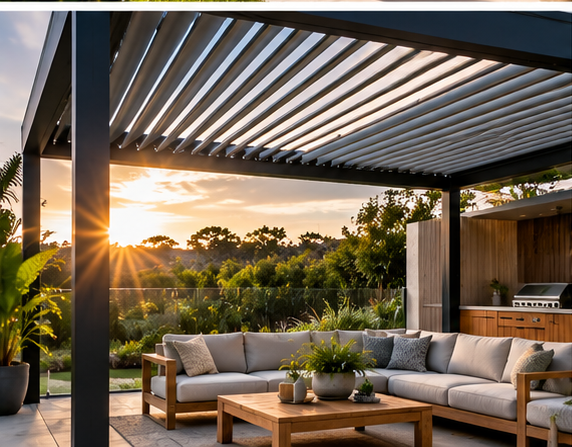
Motorised louvred pergolas offer powered roof adjustment and optional automation, while manual louvred pergolas offer simpler operation and generally lower upfront costs. In the motorised vs manual louvred pergolas decision, the best option depends on your budget, how often you’ll adjust the roof, accessibility needs, local weather, how much automation you want, and your maintenance preferences.
A motorised louvred pergola may suit homeowners who prioritise convenience, frequent roof adjustments and optional smart-home integration. A manual louvered pergola may be better for those seeking straightforward operation, lower initial costs and fewer electrical components.
| Feature | Motorised Louvred Pergola | Manual Louvred Pergola |
| Operation | Electric motor, remote or compatible controls | Hand crank or mechanical adjustment |
| Convenience | Powered adjustment | Requires physical operation |
| Weather response | Manual control or optional compatible sensors | User-operated adjustment |
| Upfront cost | Generally higher | Generally lower |
| Maintenance | Mechanical and electrical components | Primarily mechanical components |
| Power requirement | Usually requires electrical power | Typically does not require electricity |
| Accessibility | It may be easier for users with limited mobility | Requires physical access and effort |
| Smart-home integration | Available on compatible systems | Generally unavailable without modification |
| Ideal use | Frequent adjustments and automated outdoor living | Simpler setups and budget-conscious projects |
Features vary by manufacturer and model, so check the specifications of any system you’re considering. Below, we explain how each works, compare costs and maintenance, and help you decide.
What Is a Louvred Pergola and How Does It Work?
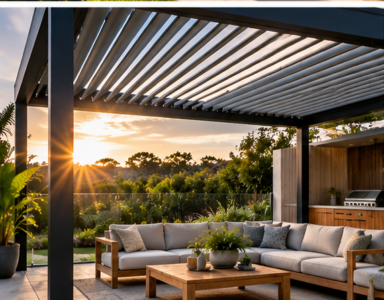
A louvred pergola is an outdoor structure with adjustable roof slats that can be opened, tilted or closed to manage sunlight, airflow and weather exposure. Louvre position changes how much sun reaches the space, the shade through the day, ventilation, heat and comfort, and, where the system is designed for it, rain protection.
The main components are supporting posts and beams, adjustable louvres, an operating mechanism (a hand crank or motorised drive), drainage channels and gutters (where included), and optional sensors, lighting and accessories.
Louvred pergolas can be freestanding or attached to a building. Common uses include dining areas, entertaining spaces, poolside seating, patios and outdoor kitchens. Not all louvred pergolas offer the same weather protection or roof adjustment. UniquePergolas’ louvred pergola range is aluminium, manual or motorised, freestanding or wall-mounted, and its listings state a height of 2.5 metres for every pergola.
What Is the Difference Between Motorised and Manual Louvred Pergolas?
The main difference is how the louvres are operated. Motorised pergolas use an electric motor and compatible controls. Manual pergolas use a mechanical mechanism, usually a hand crank.
- Motorised: a motor adjusts the louvres, controlled by a switch, a remote, or a compatible app, depending on the model. Some systems support automation or sensors, and electrical installation may be required.
- Manual: The louvres are adjusted by a crank or handle. There is no motor; it requires physical effort, and typical manual systems don’t rely on mains power.
| Consideration | Motorised | Manual |
| Control options | Switch, remote or compatible app | Crank or handle |
| Automation | Possible on compatible systems | Not normally available |
| Electrical installation | Usually required | Generally not required |
| Weather sensors | Optional on compatible models | Generally not supported |
| System complexity | Electrical and mechanical | Primarily mechanical |
The choice affects everyday convenience, installation needs and ownership costs.
What Are the Benefits of a Motorised Louvred Pergola?
Motorised louvred pergolas offer convenient roof adjustment and may add automation and accessibility benefits.
- Convenient adjustment: powered controls replace the crank, which is especially useful in frequently used entertaining areas.
- Adjustable shade and ventilation: powered adjustments make it easier to manage sun exposure and airflow throughout the day. It doesn’t automatically give better shade or weather protection than an equivalent manual roof.
- Optional weather sensors: some systems offer rain, wind or temperature-related controls. Availability, behaviour, and operating limits vary, and not every motorised pergola closes itself in rain or is safe to operate in severe weather.
- Smart-home options: some systems offer smartphone apps, schedules or lighting integration—compatibility with a given platform needs to be confirmed with the manufacturer.
- Accessibility: powered adjustment can help older homeowners, people with reduced mobility, and anyone who finds a crank hard to turn on a larger structure.
Specifications differ even within one brand. Unique Pergolas’ motorised louvred pergola is described as remote-controlled. Its flagship freestanding model adds smartphone control, a manual backup, a 24V low-voltage motor with an IP67 rating and louvres that adjust from 0° to 110°, and lists a rain sensor among its optional upgrades. The base model’s page doesn’t state sensor, app, manual backup, or smart home platform support, so ask before assuming.
Limitations include a higher purchase price, electrical installation, motor and control maintenance, reliance on power or a backup, and potential repair costs.
What Are the Advantages of a Manual Louvred Pergola?
Manual louvred pergolas provide adjustable shade and ventilation via a straightforward mechanical system.
- Lower initial cost: with no motor, electronic controls or automation equipment, manual systems may cost less. Final pricing still depends on size, materials and specification.
- Simpler operation: a crank or handle adjusts the louvres without electronic controls.
- No routine electricity requirement: typical manual systems work without a power supply, which helps where wiring would add complexity.
- Fewer electrical components: there are fewer electronic parts to maintain or replace, though manual systems still need care.
- Suits smaller areas: compact patios, courtyards, garden seating, and homeowners who rarely adjust the roof.
Unique Pergolas’ manual louvred pergola starts at 2.5 m x 2.5 m, a size its motorised range doesn’t offer (that range starts at 3 m x 3 m). Examples include a compact courtyard or a budget-conscious dining area.
Limitations include physical effort, the need to reach the mechanism, limited convenience for frequent adjustments, no automation, and difficulty operating large or multiple roof zones.
Motorised vs Manual Louvred Pergolas: Comparing Costs and Features
Motorised pergolas generally cost more upfront due to motors, controls, and electrical components, whereas manual systems usually have a lower-cost operating mechanism. Total installed cost also depends on size, materials, roofing specification, site conditions and labour.
Unique pergolas’ listings show starting prices of $3,999 for manual and $6,299 for motorised louvred pergolas, with the final price depending on size and colour. Sizes run from 2.5 m x 2.5 m to 8 m x 4 m for manual and 3 m x 3 m to 8 m x 4 m for motorised. These are DIY kit prices. The listings don’t state GST treatment, and delivery is quoted separately by postcode. The flagship freestanding 6 m x 4 m motorised model is $18,999, supply only, with installation a separate fee.
| Cost Category | Motorised Louvred Pergola | Manual Louvred Pergola |
| Pergola structure (kit) | From $6,299 | From $3,999 |
| Louvre operating system | Motor and controls | Mechanical system |
| Electrical installation | Needed for power; confirm what’s included | Generally not required |
| Weather sensors | Optional extra where offered (rain sensor listed on the flagship) | Generally unavailable |
| Smart controls | App on the flagship; remote on the base model | Generally unavailable |
| Maintenance | Mechanical and electrical servicing | Mechanical servicing |
| Replacement components | Motors, controls and mechanical parts | Mechanical parts |
Installation labour depends on the design and site. Unique Pergolas’ kits are designed for DIY assembly, and the flagship page notes that installation is a separate fee; confirm availability and cost with the team. A licensed electrician must do fixed wiring. In Victoria, for example, Energy Safe Victoria sets out this requirement, and other states have their own regulators.
Cost drivers include dimensions, materials, motor specification, roof zones, controls and sensors, lighting, electrical connections, site preparation, engineering, approvals and labour. Ongoing costs include electricity, cleaning, servicing, motor or control replacement, warranty coverage and spare parts.
Before you compare quotes:
- Compare equivalent sizes and specifications.
- Confirm whether installation is included, and ask about electrical work.
- Check whether controls and sensors are included.
- Review motor and component warranties, and spare-part availability.
- Confirm ongoing maintenance requirements.
- Review exclusions and possible variations, and get itemised quotes.
Our pergola cost guide for Australia covers pricing in more depth, and what to expect during pergola installation covers the build.
How Do Maintenance, Durability and Weather Resistance Compare?
Both types require maintenance, but motorised systems include electrical components that may require inspection or servicing. Durability and weather resistance depend mainly on design, materials, installation quality and tested performance, not the operating method alone.
| Maintenance Area | Motorised | Manual |
| Frame and louvre cleaning | Required | Required |
| Drainage channels | Required where applicable | Required where applicable |
| Mechanical inspection | Required | Required |
| Electrical components | Motor and controls | Generally none |
| Sensors | Where fitted | Generally not applicable |
| Professional servicing | May be recommended | Depends on the system |
Durability. Frame material, corrosion resistance, coastal exposure, wind loading, structural engineering, installation quality, warranties and replacement-part availability all matter, and neither operating system is universally more durable. Unique Pergolas’ product pages state compliance with N1 and N2 wind standards. Under AS 4055, wind classes run from N1 to N6 for non-cyclonic areas and depend on wind region, terrain, shielding and topography, as Lysaght’s wind classification guide explains. N1 and N2 are the two lowest non-cyclonic classes (ultimate design gust speeds of 34 and 40 m/s, against 86 m/s for N6). Exposed and hilltop sites can need a higher class, and cyclonic regions are classed separately as C1 to C4. A rating suits only sites with a matching classification, so check yours and ask for the supporting documentation.
Weather resistance. Closed louvres may provide rain protection when the system is designed and installed for that purpose, but performance varies, and no louvred pergola should be described as completely waterproof. Wind-driven rain, seals, drainage and installation quality all affect results. The flagship page describes weather-sealed louvres and integrated drainage; ask any supplier for test documentation.
Weather automation. On compatible motorised systems, sensors may adjust the roof. Still, responses vary by manufacturer, and some systems move louvres to a set position in high wind rather than simply closing them. Follow the manufacturer’s operating instructions and tested weather limits.
Routine care means:
- Clear leaves and debris, and clean the louvres according to manufacturer guidance.
- Check drainage channels and visible mechanical parts.
- Check motor, control and sensor operation where fitted.
- Look for corrosion or damage, and follow the servicing schedule.
- Arrange professional repairs when needed.
Which Louvred Pergola Is Best for Your Budget and Outdoor Space?
Motorised pergolas may suit homeowners who prioritise convenience, accessibility and automation, while manual pergolas may suit those who prioritise simplicity and lower upfront costs. Neither is right for everyone.
| Homeowner Priority | Recommended Option | Reason |
| Lower upfront budget | Manual | Generally, fewer powered components |
| Frequent roof adjustments | Motorised | Convenient powered operation |
| Smart-home integration | Motorised | Compatible systems may support automation |
| Limited mobility | Motorised | Reduced physical effort |
| Compact outdoor space | Manual or motorised | Depends on budget and convenience |
| Large entertaining area | Motorised | Powered operation may be more convenient |
| No electrical supply available | Manual | Typical manual systems don’t need electricity |
| Automated weather response | Motorised | Available with compatible sensors |
Ask yourself:
- What is the complete project budget?
- How often will you adjust the louvres, and is powered operation important?
- Are there accessibility needs, and is smart-home compatibility or weather sensing a priority?
- Is an electrical connection available?
- How much maintenance is acceptable, and how large is the area?
- Will it be freestanding or attached, and what warranty and servicing support is available?
- Are local approvals required (see our guide to pergola council approval in Australia), and might you motorise later?
Compare actual product specifications rather than assuming every motorised or manual system has the same features, and ask for a demonstration or detailed specification before choosing. For unusual sites or sizes, see our comparison of custom pergolas versus fixed-size kits. When choosing between motorised and manual louvred pergolas, the right answer depends on how you’ll use the space. Our DIY aluminium pergola kits include both.
Get Help Choosing Your Louvred Pergola
Ready to compare options? Talk through your budget, roof configuration and preferred level of convenience with the team. You can browse the louvred pergola range or the motorised louvred pergolas, read about custom pergolas, or see what installation involves. Weather performance, automation compatibility and installed costs depend on the specific product and site, so confirm them before you order.
Get a Free Quote or call 03 4250 8999
Frequently Asked Questions
How Much Does a Motorised Louvred Pergola Cost in Australia?
Unique Pergolas’ DIY motorised louvred pergola kits start from $6,299, with the final price depending on size and colour. Its flagship freestanding 6 m x 4 m model is $18,999, supply only. Installation and delivery are separate; the listings don’t state GST treatment;,and a licensed electrician is required for the power connection. Other suppliers’ prices vary, so get an itemised quote for your property.
Are Motorised Louvred Pergolas Worth the Extra Cost?
They can be, depending on your priorities. Motorised systems may justify the extra cost if you value convenient operation, frequent roof adjustments, accessibility and optional automation. Manual systems may offer better value when budget and mechanical simplicity matter most. Motorisation doesn’t guarantee a financial return, so weigh the extra cost against how often you’ll actually use the controls.
Can You Manually Operate a Motorised Pergola During a Power Outage?
It depends on the motor, drive mechanism and any emergency override. Some systems include a manual override or backup power, while others can’t be operated without electricity. Unique Pergolas’ flagship page lists a manual backup, but the base motorised page doesn’t state one, so confirm the procedure for your model. Never force the mechanism.
Are Louvred Pergolas Waterproof When Closed?
Not necessarily. Some are designed to give rain protection when fully closed. Still, performance varies with product design, sealing, drainage and installation quality, and heavy rain or wind-driven water can affect results. Unique Pergolas’ flagship page describes weather-sealed louvres and integrated drainage, yet no louvred pergola should be assumed completely waterproof without verified product testing.
Can a Manual Louvred Pergola Be Upgraded to Motorised Operation?
Sometimes, but not always. Compatibility depends on the pergola’s design, mechanical components, manufacturer specifications, and electrical requirements; some manual systems can’t be converted economically or safely. Unique Pergolas sells manual and motorised pergolas as separate products, and its product pages don’t describe a conversion, so confirm retrofit compatibility with the manufacturer or a qualified installer before buying.