Blog
Louvred & Motorised Pergolas: Cost, Control & Installation Explained

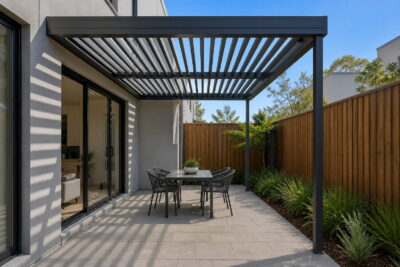
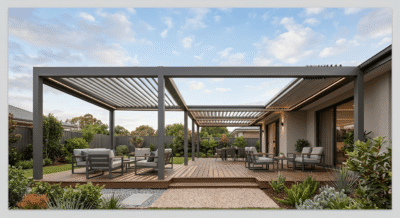
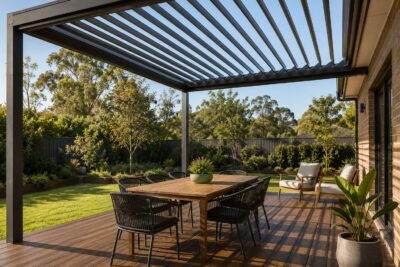
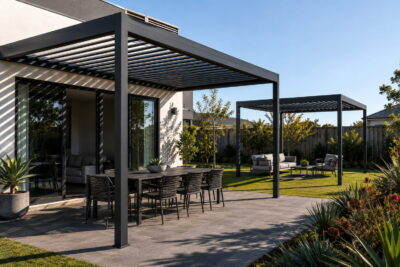
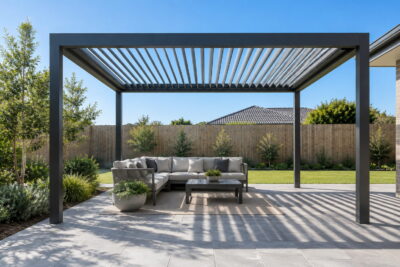
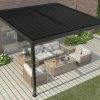
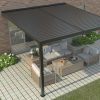
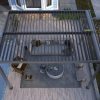
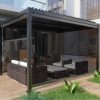
A louvred pergola uses adjustable roof blades to control sunlight, shade and airflow, and on compatible systems, closing the louvres directs rainwater into integrated gutters and downpipes. Motorised models let you adjust the blades with a wall switch, remote, sensor or compatible app, while a manual crank offers a simpler, lower-cost alternative. These systems generally cost more than a fixed-roof pergola and need careful structural, drainage and electrical planning. A louvred pergola is an outdoor structure with adjustable roof blades that rotate to control sunlight, ventilation, and rain protection. Performance and available controls vary between products, so always confirm what a specific system includes before you buy.
How Do Louvred and Motorised Pergolas Work?
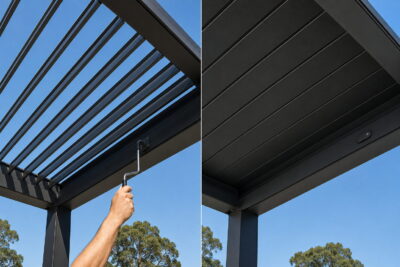
The roof contains pivoting louvres connected to a manual crank or an electric motor, and the blades rotate between three main positions:
- Open: lets in direct sunlight and upward airflow.
- Angled: gives partial shade while keeping some ventilation.
- Closed: provides the most overhead coverage and directs water to the drainage system.
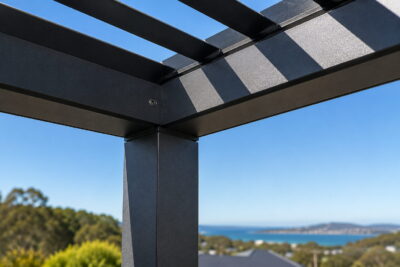
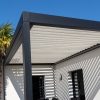
The main components are the aluminium louvres, perimeter beams, posts or wall connections, the manual or motor drive with its linkages, a controller (wall switch, remote or sensor input), integrated gutters and downpipes, and the footings or structural fixings that hold it all up.
In This Guide
- How Do Louvred and Motorised Pergolas Work?
- What Are the Benefits of an Adjustable Pergola Roof?
- How Do Louvres Control Light, Airflow and Rain?
- How Much Does a Motorised Pergola Cost in Australia?
- What Does Installation Involve?
- What Should You Check Before Choosing a Louvred or Motorised Pergola?
- How Much Maintenance Does a Louvred or Motorised Pergola Need?
- Get a Free Quote
- Frequently Asked Questions
Manual Versus Motorised
| Feature | Manual System | Motorised System |
|---|---|---|
| Operation | Hand crank | Electric motor |
| Convenience | Suits occasional adjustment | Easier for frequent use |
| Remote or app control | No | Often available |
| Electrical work | Not required | Usually required |
| Installation complexity | Lower | Higher |
| Initial cost | Lower | Higher |
Motorising a pergola does not change its structural capacity; wind rating and footings still depend on the frame and site, not the drive type. Our comparison of manual versus motorised louvred pergolas looks at which suits which household.
Fixed Roof Versus Adjustable Roof
| Consideration | Fixed Roof | Adjustable Louvred Roof |
|---|---|---|
| Sunlight | Set by the roofing material | Controlled by the louvre position |
| Ventilation through the roof | Limited | Available when open |
| Moving parts | None or minimal | Motor, linkages and pivots |
| Electrical work | Optional accessories only | Required for motorised operation |
| Relative cost | Lower | Higher |
| Best suited to | Consistent shade or shelter | Adjustable outdoor use |
Our guide to retractable and opening roofs weighs up whether the extra cost and complexity are worth it for your household.
What Are the Benefits of an Adjustable Pergola Roof?
An adjustable roof offers more control over sunlight, shade, and ventilation than a fixed roof, though its value depends on your climate, orientation, and how often you use the space. Potential benefits include opening to sunlight, tilting for filtered shade, closing for greater rain coverage, seasonal flexibility, a defined entertaining area, and (on motorised models) convenient push-button or app control. Limitations include a higher initial cost, more moving parts to maintain, periodic cleaning and inspection, a need for power on motorised units, and the fact that closed louvres do not stop wind-driven rain from the sides.
Expectations Versus Reality Table
| Goal | Potential Benefit | Important Qualification |
|---|---|---|
| More winter sun | Open the roof when conditions suit | Orientation affects how much sun you actually get |
| Summer shade | Angle or close the louvres | Low side sun may still need screens |
| Better ventilation | Open louvres allow airflow upward | Still-air conditions limit natural airflow regardless |
| Use the space in light rain | Close louvres and rely on drainage | Wind-driven rain can still enter from open sides |
| Simplify daily operation | Use motorised controls | Needs power and occasional servicing |
How Do Louvres Control Light, Airflow and Rain?
Louvre Position Reference Table
| Louvre Position | Light | Airflow | Rain Coverage | Typical Use |
|---|---|---|---|---|
| Fully open | Highest | Highest | Minimal | Clear, mild weather |
| Partially angled | Filtered | Moderate | Limited | Shade with ventilation |
| Mostly closed | Low | Limited | Increased | Strong sun or light rain |
| Fully closed | Lowest | Minimal | Highest available | Rain or strong overhead sun |
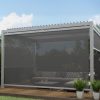
Side screens can improve protection against low-angle sun and rain, but they also reduce airflow and increase wind load on the structure, so factor them into your wind rating and footing design rather than adding them as an afterthought. Some manufacturers offer rain, wind, or sun sensors that automatically adjust the roof. Still, sensor availability is product-dependent, requires proper power and commissioning, and does not guarantee the roof closes before water gets in. Always confirm which sensors, if any, are included with your specific system, and follow the manufacturer’s high-wind operating instructions rather than relying on automation alone.
How Much Does a Motorised Pergola Cost in Australia?
Motorised pergola prices depend on size, frame specification, the louvre system, controls, footings, drainage and any electrical work. As a current, verified example, Unique Pergolas prices its DIY aluminium kits as follows on the pergola range:
| Pergola Option | Typical Price (Supply Only, DIY) | Notes |
|---|---|---|
| Manual adjustable pergola kit | $3,999 – $8,999 | Hand-crank louvres, fixed at 2.5 m roof height |
| Motorised louvred pergola | $6,299 – $10,999 | Freestanding, remote-controlled louvres |
| Wall-mounted motorised louvred pergola | $6,299 – $10,999 | Remote-controlled, attaches to an existing wall |
| Freestanding motorised pergola (flagship range) | Around $18,999 | 6 m x 4 m, app and remote control, integrated LED lighting, IP67-rated motor — current promotional price, reduced from $29,999 |
These are supply-only DIY kit prices and do not include a concrete slab, new footings, electrical connection for the motor, or professional installation if you choose to hire a tradesperson. Prices and inclusions change, so check the current pergola range before budgeting. Our pergola cost guide for Australia covers custom and professionally installed structures, which sit in a wider, generally higher price range.
What Affects the Price
- Roof span and number of louvre bays
- Manual or motorised operation, and the number of motors
- Attached versus freestanding configuration
- Wind rating and any required engineering
- Footings and whether a new concrete base is needed
- Remote, app or sensor inclusions
- Electrical work, lighting or screens
- Council or certifier fees, where approval applies
What a Kit Price Typically Does Not Include
- A new concrete slab or footings
- Electrical connection for the motor and controls
- Additional remotes, sensors or smart-home hubs
- Screens, lighting or heating
- Professional installation, if you do not build it yourself
What Does Installation Involve?
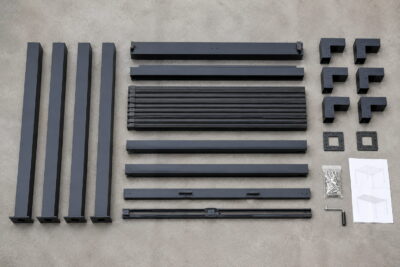
Installing a louvred pergola involves site measurement, checking the surface and footings, assembling the frame and louvres, fitting drainage, and, for motorised systems, a licensed electrical connection. Unique Pergolas’ kits are designed for DIY assembly: typically built by two to three adults in around three hours, using the supplied step-by-step instructions and videos. Our guide to what to expect during pergola installation covers site preparation in more detail.
| Existing Surface | Can a Pergola Be Installed? | What to Check |
|---|---|---|
| Purpose-built concrete slab | Yes | Thickness, reinforcement and footing positions |
| Existing patio slab | Possibly | Age, condition and load capacity |
| Pavers | Yes, with independent footings | Pavers are not a structural footing on their own |
| Timber or composite deck | Possibly | Underlying framing and post connections, not just the surface |
| Bare soil | Yes | Excavation, footings and drainage fall |
| Rooftop, balcony or pool surround | Specialist assessment needed | Structural capacity, waterproofing and pool-barrier rules |
An existing slab does not automatically remove the need for independent footings under the posts.
Electrical Requirements
A motorised louvre system needs a suitable power supply, an isolation switch, and wiring to the motor, controller and any sensors or lighting. In Victoria, all fixed electrical installation work must be completed by a licensed electrician or registered electrical contractor, who must issue a Certificate of Electrical Safety. Energy Safe Victoria sets out this requirement and how to check a contractor’s licence. Every other state and territory has its own electrical safety regulator, so use the equivalent check for your location. Depending on your structure and location, a motorised pergola may also trigger council approval requirements; our state-by-state guide to pergola council approval in Australia covers when that applies.
What Should You Check Before Choosing a Louvred or Motorised Pergola?
Before choosing a system, check orientation, the coverage you need, structural support, drainage, available controls, weather exposure and budget. Site and design: intended use and seating layout, internal usable dimensions, post positions, door and window clearance, sun direction and prevailing wind, roof fall and downpipe locations, the existing surface and footing requirements, and any coastal, bushfire or pool-barrier constraints. Controls and features: manual or motorised operation, number of remotes, whether app or sensor control is included, a manual override for power outages, and whether lighting, heating or screens are compatible with your chosen system.
| Priority | Recommended Starting Option | Important Consideration |
|---|---|---|
| Lowest cost | Manual adjustable pergola | Requires hand operation |
| Frequent adjustment | Motorised louvred pergola | Needs electrical work and occasional servicing |
| Rain responsiveness | System with a rain sensor, if offered | A sensor does not guarantee full protection |
| Coastal site | Exposure-suitable aluminium system | Confirm coatings, hardware and cleaning needs |
| Existing slab or pavers | Site assessment first | The surface may not double as the footing |
| Attached to the house | Engineered wall connection | Flashing and drainage must tie in properly |
Before ordering, ask your supplier which controls are standard versus optional, how the louvres respond to rain, what the high-wind operating procedure is, who is responsible for engineering and approvals, what happens during a power outage, and which warranties cover the frame, finish, motor and any installation work.
How Much Maintenance Does a Louvred or Motorised Pergola Need?
| Maintenance Task | Suggested Frequency | Purpose |
|---|---|---|
| Clear leaves and debris | Regularly, and after storms | Keeps the roof and drainage clear |
| Clean gutters and outlets | Several times a year | Reduces overflow risk |
| Wash frame and louvres | As needed for your location | Removes dirt, salt and residue |
| Test roof movement | Periodically | Picks up noise or uneven operation early |
| Check remote batteries and sensors | As needed | Keeps controls reliable |
| Arrange professional servicing | As the manufacturer recommends | Maintains motors and moving parts |
Do not force jammed louvres or open a motor housing yourself; have a persistent fault checked by a qualified technician. Choosing between a manual and a motorised louvred pergola comes down to how often you will adjust it, your budget, and how much ongoing servicing you are willing to take on. Both give more control over sun, shade, and rain than a fixed roof, provided the drainage, footings, and, for motorised systems, the electrical work are properly planned from the start.
Frequently Asked Questions
Can a Motorised Pergola Be Used When It Rains?
Compatible louvred roofs can be closed to give greater overhead rain coverage and direct water into integrated drainage. Wind-driven rain can still enter through open sides, though, and performance depends on the specific system, seals, gutters and installation quality. Follow the manufacturer’s weather and operating instructions rather than assuming full protection in every condition.
How Are Motorised Pergolas Controlled?
Motorised pergolas may use a wall switch, a handheld remote, a sensor, or a compatible app, though available controls vary by system. Unique Pergolas’ motorised range includes remote control as standard, with app control on the flagship freestanding model. Confirm which devices are included and how the roof operates if the internet or power connection fails.
Do Motorised Pergolas Require an Electrician?
Yes. Fixed wiring for a motorised pergola’s motor, isolation switch, controls and any lighting must be completed by a licensed electrician, who will issue a Certificate of Electrical Safety in Victoria and the equivalent documentation elsewhere in Australia. Confirm whether electrical labour is included in your quote or needs to be arranged separately.
What Happens if the Pergola Loses Power?
A motorised pergola generally stays in its current louvre position during a power outage. Some systems include a manual override or backup procedure, but this is not universal, so confirm the product-specific process with your supplier and know how to use it before severe weather arrives.
How Much Maintenance Does a Louvred Pergola Require?
Get a Free Quote
If you are comparing options, browse the current range of manual and motorised aluminium pergola kits or get in touch with the team with your dimensions and preferred controls. Get a Free Quote or call 03 4250 8999
Routine maintenance includes clearing leaves and debris, cleaning gutters, washing the louvres and frame, and checking that the roof still moves smoothly. Motorised systems also need occasional checks of the motor, controller and any sensors. Coastal or leafy sites usually need more frequent cleaning, so follow the manufacturer’s care and servicing schedule.