Blog
Which Pergola Roofing Kit Is Best for the Australian Climate and Fits a Standard-Size Pergola?

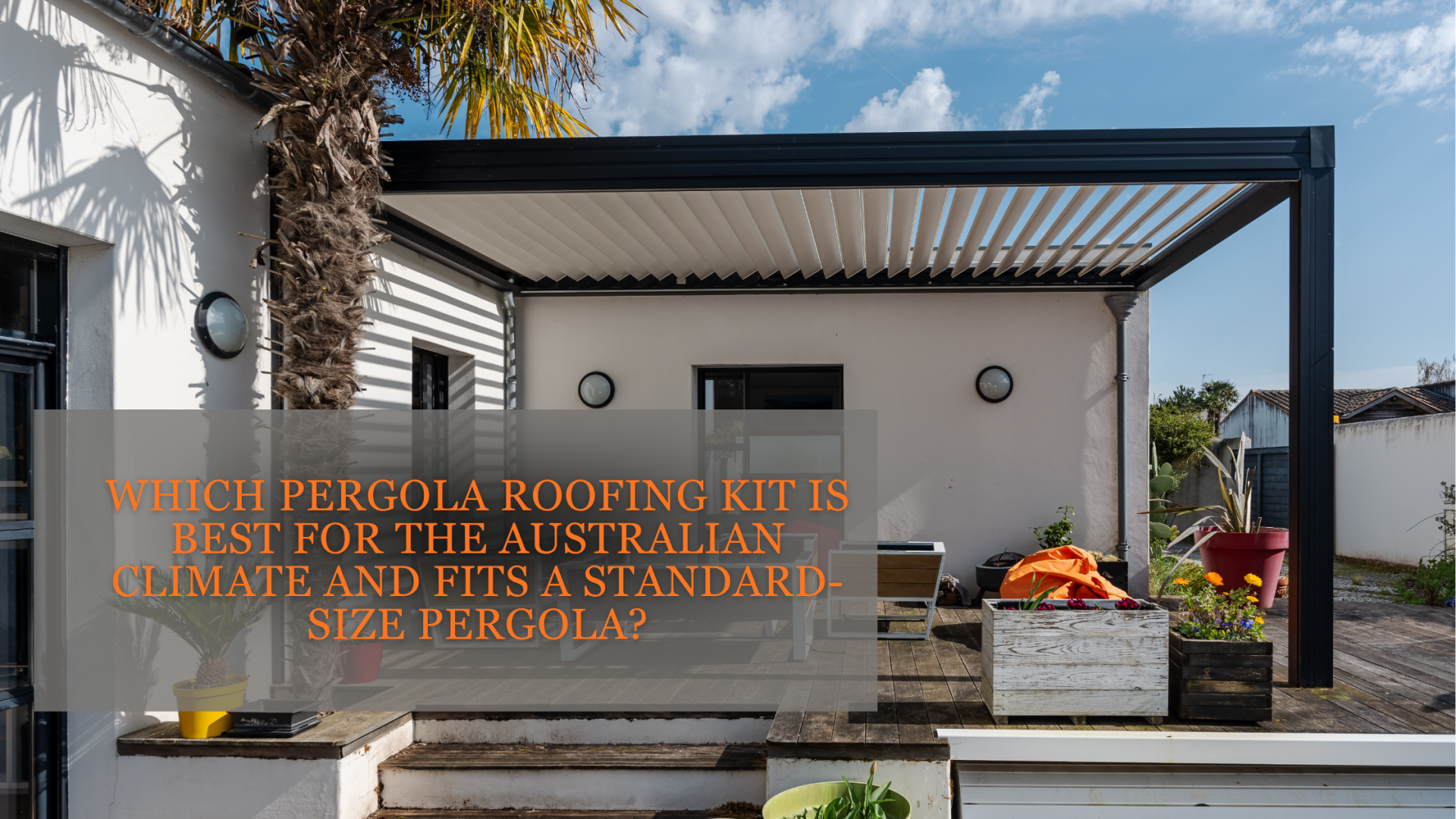
Choosing a pergola roof isn’t just a style decision. In Australia, the roof is what decides whether your outdoor space survives the next heatwave, hailstorm or humid summer without cracking, rusting or fading. Homeowners searching for the right pergola roofing kit for the Australian climate usually want the same three things: real weather protection, a fit for a standard-size structure, and a material that won’t need constant upkeep.
This guide compares the main pergola roofing materials sold in Australia, explains which ones perform best in local conditions, and shows how to match a roofing kit to a standard-size pergola without overspending or under-protecting your space.
What Makes a Pergola Roof “Climate-Ready” in Australia?
Direct answer: A climate-ready pergola roof resists UV degradation, sheds heavy rain, withstands wind loads, and doesn’t corrode, warp or rot over time.
Australia isn’t one climate, it’s several. Northern Queensland deals with cyclones and monsoonal rain. Coastal cities face salt-laden air that accelerates corrosion. Inland regions swing between extreme summer heat and frosty winter nights. A roofing material that performs well in Hobart may fail faster in Darwin, and vice versa.
Three factors matter most when assessing a pergola roof for Australian conditions.
UV exposure is a major test for outdoor materials. Australia records some of the highest UV Index readings in the world, with average values of 11 or more (Extreme) across most of the country in January (Source: Bureau of Meteorology). Roofing materials that aren’t UV-stabilised will fade, chalk or become brittle well before a decade is up.
Wind and storm loading is the second factor. Structural design for pergolas, carports and similar structures in Australia is governed by wind action standards that account for regional wind speed, terrain and structure height (Source: Standards Australia, AS/NZS 1170.2:2021). A roofing kit that hasn’t been engineered with wind loads in mind is a liability in storm season.
Corrosion resistance is the third. Ongoing atmospheric corrosivity research shows that salinity and “time of wetness” are the two biggest drivers of metal corrosion in the Australian environment, with coastal and tropical zones rated more corrosive than dry inland areas (Source: Galvanisers Association of Australia, citing CSIRO corrosion mapping research). This is why the material and coating system matter as much as the roof shape.
Example: A timber lattice roof in a coastal Queensland backyard may need re-oiling every year to avoid greying and rot, while a powder-coated aluminium louvered roof in the same spot needs little more than an occasional rinse.
Best practice: Match the roofing material to your specific exposure, not just your budget. A slightly higher upfront cost on a durable pergola roofing material is usually cheaper than repainting, resealing or replacing a roof every few seasons.
Key takeaway: Climate-ready means UV-stable, wind-rated and corrosion-resistant, not just “waterproof.”
Which Pergola Roofing Kit Is Best for the Australian Climate?
Direct answer: Powder-coated aluminium louvered roofing kits are best for most Australian climates, because they combine weather resistance, adjustable shade and low maintenance in one system.
If you shop for a pergola roof kit Australia-wide, you’ll find four roofing types dominate the market: aluminium louvres, polycarbonate sheeting, timber battens, and shade cloth or fabric canopies. Each behaves differently once exposed to Australian sun, rain and wind.
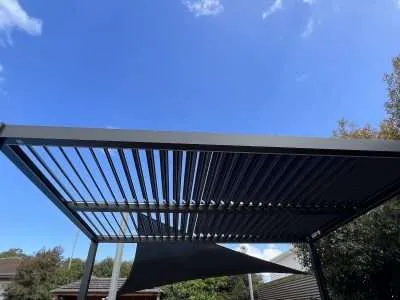
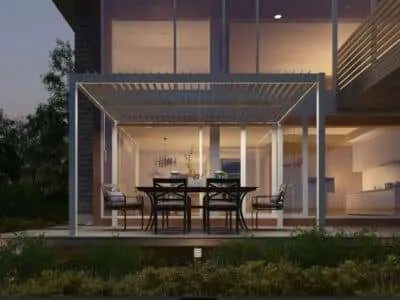
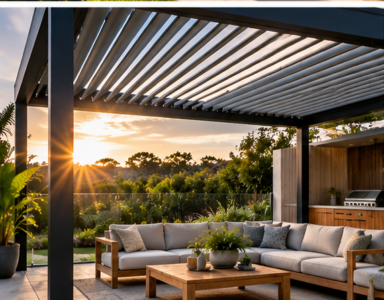
Aluminium louvered roofing is built from powder-coated aluminium extrusions that open and close to control light, shade and airflow. It resists rust, fading and warping without repainting, and is generally engineered to handle storms, hail and strong winds. Because it’s fully adjustable, it also solves a problem fixed roofs can’t: letting winter sun in while blocking summer glare.
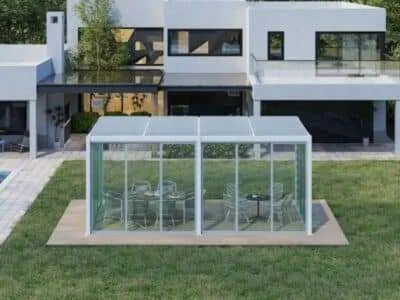
Polycarbonate roofing is lightweight and translucent, allowing diffused light to pass while blocking UV. It performs reasonably well against sun and rain but can be noisier in heavy rain and hail, and lower-grade sheets can yellow with age if UV additives are thin.
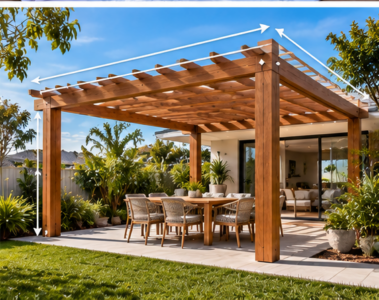
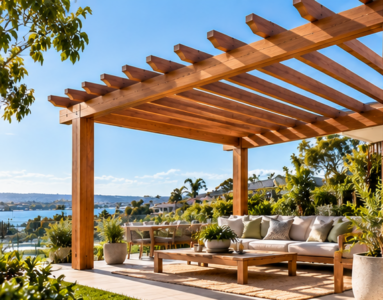
Timber battens or lattice roofs suit a natural aesthetic, but timber is vulnerable to Australian conditions. It requires regular oiling, staining, or sealing, and is more prone to termite damage, rot, and warping in humid or coastal zones.
Shade cloth or fabric canopies are the least weather-resistant option. They filter UV well but offer no real rain protection and typically need to be replaced every few years as the fabric breaks down under constant sun exposure.
Example: A homeowner in a coastal suburb comparing a timber-roofed pergola against an aluminium louvered kit will usually find the aluminium option holds its finish and structural integrity for a decade or more, while the timber option needs re-coating within one to two years to avoid greying and cracking.
Best practice: If your priority is a genuinely “set and forget” roof, choose adjustable aluminium louvres with a factory powder-coat finish and a written structural warranty.
Key takeaway: For the Australian climate specifically, powder-coated aluminium louvered roofing kits offer the strongest balance of durability, adjustability and low maintenance.
Standard-Size Pergola Roofing Kit: Getting the Fit Right
Direct answer: A standard-size pergola roofing kit typically ranges from around 2.5m x 2.5m for small courtyards up to 8m x 4m for larger entertaining areas, with a fixed height of around 2.5m.
Getting the size right matters as much as the material. An undersized roof leaves furniture and doorways exposed to rain and glare at the edges. An oversized roof can overwhelm a small courtyard or trigger council approval requirements that a smaller, exempt structure would have avoided.
Standard pergola roofing kits in the Australian market are generally sold in fixed width-and-depth combinations, such as 3m x 3m, 4m x 3m, 4m x 4m, 6m x 4m and up to around 8m x 4m, so homeowners can match a kit to an existing deck, patio or poolside slab rather than commissioning a custom structure.
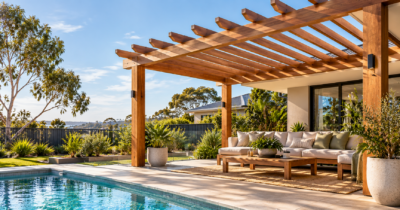
Example: A narrow side yard or small courtyard is usually better suited to a compact wall-mounted pergola kit, since it needs less floor space than a freestanding structure of the same coverage. A larger open deck or poolside area, on the other hand, can accommodate a bigger footprint from the Unique Deluxe Freestanding Range without crowding the space.
Best practice: Measure your existing paved or decked area first, then choose the closest matching standard size. See our guide on preparing your backyard for pergola installation for footing and drainage allowances before you order.
Key takeaway: Standard-size pergola roofing kits are designed to fit common backyard footprints without custom fabrication, so measure before you buy.
Weather-Resistant Pergola Roof Materials Compared
Direct answer: Powder-coated aluminium is the most weather-resistant standard pergola roofing material, followed by UV-stabilised polycarbonate, with timber and fabric ranking lowest for durability in Australian conditions.
| Roofing Material | UV Resistance | Rain/Storm Performance | Maintenance Needed | Typical Lifespan | Best For |
| Powder-coated aluminium (louvered) | Excellent | Excellent, adjustable louvres shed rain | Minimal, occasional rinse | 10+ years | Most Australian climates |
| UV-stabilised polycarbonate | Good | Good, can be noisy in hail | Low, occasional cleaning | 8–15 years | Light-filled fixed roofs |
| Timber battens/lattice | Fair, greys without treatment | Fair absorbs moisture | High, regular oiling/sealing | 5–10 years with upkeep | Natural aesthetic, low-exposure areas |
| Shade cloth/fabric canopy | Fair to good | Poor, minimal rain protection | Moderate, seasonal replacement | 2–5 years | Shade only, dry climates |
Example: Fixed shade sails are popular for pure sun protection, but aren’t a substitute for a genuine weather-resistant pergola roof if year-round outdoor use, including wet weather, is the goal.
Best practice: If your outdoor area needs to function in both summer heat and winter rain, prioritise materials rated “excellent” or “good” for both UV resistance and rain performance in the table above.
Key takeaway: Aluminium and quality polycarbonate outperform timber and fabric on weather resistance across nearly every Australian climate zone.
Best Roofing for Outdoor Pergolas by Climate Zone
Direct answer: The best roofing for outdoor pergolas depends on regional exposure: aluminium louvres suit coastal and cyclone-prone regions, while adjustable roofing generally outperforms fixed roofing in hot, high-UV inland zones.
Australia’s building and bushfire standards recognise that risk varies by location, and roofing choices should follow the same logic.
In cyclone and high-wind regions of northern Australia, structures should be assessed against regional wind speed classifications under the relevant wind actions standard (Source: Standards Australia, AS/NZS 1170.2:2021). louvered aluminium systems with engineered fixings are generally better suited here than lightweight fabric or unsecured lattice.
In bushfire-prone areas, Bushfire Attack Level (BAL) ratings determine construction requirements, and non-combustible materials such as aluminium are recognised as suitable external materials for BAL ratings from BAL-12.5 through to BAL-40 (Source: Standards Australia, AS 3959:2018). Homeowners in mapped bushfire zones should confirm their property’s BAL rating with their local council or a bushfire consultant before finalising material choices.
In coastal areas, higher salinity and time-of-wetness increase corrosion risk, so a quality powder coat over aluminium, rather than untreated steel or timber, is the more resilient option (Source: Galvanisers Association of Australia, citing CSIRO corrosion mapping research).
In hot, high-UV inland and northern zones, adjustable louvres that can close for shade during peak UV hours and open for airflow in the evening offer more year-round comfort than a fixed solid roof. In exposed or windy positions, pairing a roofing kit with pull-up screens adds a second layer of protection against driving rain and wind without sacrificing airflow control.
Example: A Perth homeowner near the coast and a Darwin homeowner in a cyclone-rated wind region have different risk profiles, but both are better served by a wind-rated, corrosion-resistant aluminium roofing kit than by timber or fabric.
Best practice: Always check your property’s wind region, bushfire overlay (if any) and coastal exposure before ordering a kit, and ask the supplier whether their structure has been engineered against relevant wind actions.
Key takeaway: There’s no single “best” roof for all of Australia, but aluminium louvered systems perform consistently well across the widest range of climate zones and risk categories.
How to Choose a DIY Pergola Kit in Australia: A Step-by-Step Process
Direct answer: Choosing a DIY pergola kit in Australia comes down to five steps: measure your space, assess your climate risk, pick a material, choose manual or motorised operation, and confirm council requirements.
- Measure the available footprint, including clearance from boundaries, eaves and existing structures.
- Identify your local climate risks, including wind region, bushfire overlay and coastal exposure.
- Choose a roofing material based on the comparison above, prioritising aluminium for most standard applications.
- Decide between manual and motorised operation. Manual louvered pergola kits are more affordable and simple to operate by hand crank, while motorised louvered pergola kits add push-button or remote control and, in some ranges, built-in lighting.
- Check whether your structure needs council approval and an exempt development status. Rules vary by state and council, and even a compliant pergola can lose its exempt status if it’s attached to a boundary, near a heritage overlay, or above a certain size (Source: NSW Planning Portal, Balconies, Decks and Patios).
Example: A homeowner planning a straightforward 3m x 3m manual louvered pergola on an existing paved patio, well clear of boundaries, is far more likely to qualify for a simplified approval pathway than someone planning a large structure attached to a heritage-listed home.
Best practice: Confirm council requirements before ordering, not after. It’s far cheaper to check a planning portal than to modify or relocate an installed structure.
Key takeaway: A good DIY decision process checks climate, size and compliance together, not the roofing material in isolation.
Common Mistakes When Choosing a Pergola Roofing Kit
Direct answer: The most common mistakes are choosing style over durability, ignoring local wind and bushfire ratings, undersizing the roof, and skipping council checks.
Many buyers pick a roofing material purely on appearance, without checking how it performs against UV or rain in their specific region. Others assume all pergola kits are engineered the same way, when wind and structural ratings can vary significantly between suppliers. A frequent sizing mistake is choosing a roof that doesn’t fully cover outdoor furniture or a doorway, leaving gaps exposed to driving rain. Finally, some homeowners install a structure first and check council rules afterwards, which can lead to costly rework.
Example: A pergola built two metres from a side boundary without checking exempt development rules may later need retrospective approval or modification, adding cost and delay that proper research would have avoided.
Best practice: Treat material selection, sizing and compliance as one decision, made before purchase, not three separate afterthoughts.
Key takeaway: Most pergola regrets come from rushing the decision, not from a bad roofing material on its own.
Durable Pergola Roofing Materials: What “Durable” Really Means
Direct answer: Durable pergola roofing materials are those that maintain structural integrity, colour and weatherproofing over many years with minimal intervention, not simply materials that are heavy or expensive.
Durability isn’t just about a material surviving one storm. It’s about consistent performance across repeated UV exposure, rain cycles, temperature swings and, in some regions, salt air, without needing repainting, resealing or structural repair. Powder-coated aluminium meets this definition well because the coating is baked onto the metal, rather than applied as a surface layer that wears off, giving it strong resistance to atmospheric corrosion (Source: Standards Australia, guidance on protective coatings for structural metals, AS/NZS 2312 series).
Example: Two pergolas installed on the same day, one in powder-coated aluminium and one in raw timber, will typically show a visible difference in weathering within two to three years, well before either structure reaches the end of its practical life. For a closer look at how these issues actually appear in Australian backyards, see our guide to common rust, rot, and how to fix problems in outdoor structures.
Best practice: Ask any supplier what warranty backs the structure and finish. A genuine multi-year structural warranty is a reasonable proxy for the durability the manufacturer expects from the material.
Key takeaway: True durability is measured in years of low-maintenance performance, not just initial build quality.
Where a Standard-Size Pergola Fits Into Your Outdoor Living Plan
Direct answer: A standard-size pergola roofing kit works best when it’s sized to match an existing or planned outdoor living zone, such as a deck, patio or poolside area, rather than the maximum space available.
Pergolas sit between fully open outdoor space and a fully enclosed room. Unlike a gazebo, which is a standalone structure with a full roof, or a verandah, which is a solid roofed area attached to the home, a pergola is designed to give adjustable shade and airflow rather than complete enclosure. That distinction matters when sizing a roof, because the goal isn’t maximum coverage, it’s the right coverage for how the space will be used.
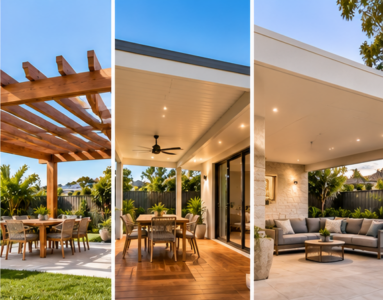
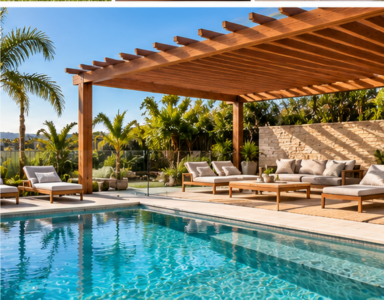
Example: A pergola built primarily for outdoor entertaining and dining generally performs best sized to fully cover a table and walking space around it, while a pergola built mainly for poolside lounging can be sized more generously to shade loungers without blocking the breeze that keeps the area comfortable.
Best practice: Plan the roofing kit size around furniture layout and daily use patterns, guided by our tips on pergola placement for sun, breeze and privacy, not just the boundary of the paved area.
Key takeaway: The best-fitting standard-size pergola is chosen around how you’ll actually use the space, not just how much space you have.
Summary
The pergola roofing kit best suited to the Australian climate, for most homes and most standard sizes, is a powder-coated aluminium louvered roof. It resists UV fading, rain, wind and corrosion far better than timber, fabric or lower-grade polycarbonate, and adjustable louvres add year-round flexibility that fixed roofs can’t match. Standard-size kits, generally ranging from 2.5m x 2.5m up to around 8m x 4m, cover most Australian backyard footprints, but the right fit depends on measuring your space, assessing local wind and bushfire risk, and confirming council requirements before you buy.
Frequently Asked Questions
Does a pergola roof need to be rated for wind and hail, or is any aluminium roof strong enough?
Not all aluminium roofing is engineered the same way. Wind performance depends on the specific design, fixings and regional wind classification under Australia’s wind actions standard, so it’s worth confirming a kit’s engineering credentials rather than assuming aluminium alone guarantees storm resistance (Source: Standards Australia, AS/NZS 1170.2:2021).
Can I install a weather-resistant pergola roof myself, or do I need a builder?
Many standard-size DIY pergola kits are designed for owner installation, typically with two to three adults and basic tools, and come with step-by-step instructions. More complex sites, such as sloped ground or difficult drainage, may still benefit from professional help with footings.
Will a louvered aluminium roof leak when the louvres are closed?
Quality louvered systems are designed with overlapping blades and drainage channels so that closed louvres shed rain effectively. Leaks are more often caused by poor installation or incorrect pitch than by the material itself.
How do I know if my area counts as a high-corrosion zone?
Coastal proximity, rainfall and humidity all affect corrosion risk. If you’re within a few kilometres of the coast or in a consistently humid region, treat corrosion resistance as a higher priority when comparing roofing materials.
Is a motorised pergola roof more weather-resistant than a manual one?
Weather resistance comes from the material and coating, not the operating mechanism. Motorised and manual louvered roofs in the same material will perform similarly against UV, rain and corrosion; the motor simply adds convenience.
Conclusion
Deciding which pergola roofing kit is best for the Australian climate comes down to matching material durability to your specific exposure, then fitting that material to a standard pergola size that suits how you actually use your outdoor space. Powder-coated aluminium louvered roofing consistently outperforms timber, fabric and lower-grade polycarbonate across most Australian regions, offering UV stability, storm resistance and low maintenance in one system. Measure your space, check your local wind and bushfire risk, confirm council requirements, and choose a roofing kit backed by a genuine structural warranty. Browse the full pergola range to compare standard sizes from 2.5m x 2.5m through to 8m x 4m in powder-coated aluminium, manual or motorised, and match a climate-ready roof to your space without a custom build.
External References
Australian Building Codes Board. ABCB — National Construction Code. 2026. https://www.abcb.gov.au/ Accessed 29 July 2026.
Bureau of Meteorology. About the UV Index. 2026. https://www.bom.gov.au/resources/learn-and-explore/uv-knowledge-centre/about-the-uv-index Accessed 29 July 2026.
Bureau of Meteorology. Average Solar Ultraviolet (UV) Index — Climate. 2026. https://www.bom.gov.au/climate/maps/averages/uv-index/ Accessed 29 July 2026.
Galvanizers Association of Australia. Corrosivity in the Australian Atmosphere. 2024. https://gaa.com.au/2024/06/07/corrosivity-in-the-australian-atmosphere/ Accessed 29 July 2026.
NSW Government (NSW Planning Portal). Balconies, Decks and Patios — Exempt Development. 2026. https://www.planningportal.nsw.gov.au/development-and-assessment/planning-approval-pathways/exempt-development/balconies-decks-and-patios Accessed 29 July 2026.
Standards Australia. AS/NZS 1170.2:2021 — Structural Design Actions, Part 2: Wind Actions. 2021. https://store.standards.org.au/product/as-nzs-1170-2-2021 Accessed 29 July 2026.
Standards Australia. AS 3959:2018 — Construction of Buildings in Bushfire-Prone Areas. 2018. https://store.standards.org.au/product/as-3959-2018 Accessed 29 July 2026.
Standards Australia. AS/NZS 2312.1:2014 — Guide to the Protection of Structural Steel and Other Metals Against Atmospheric Corrosion by the Use of Protective Coatings. 2014. https://www.standards.govt.nz/shop/asnzs-2312-12014 Accessed 29 July 2026.